
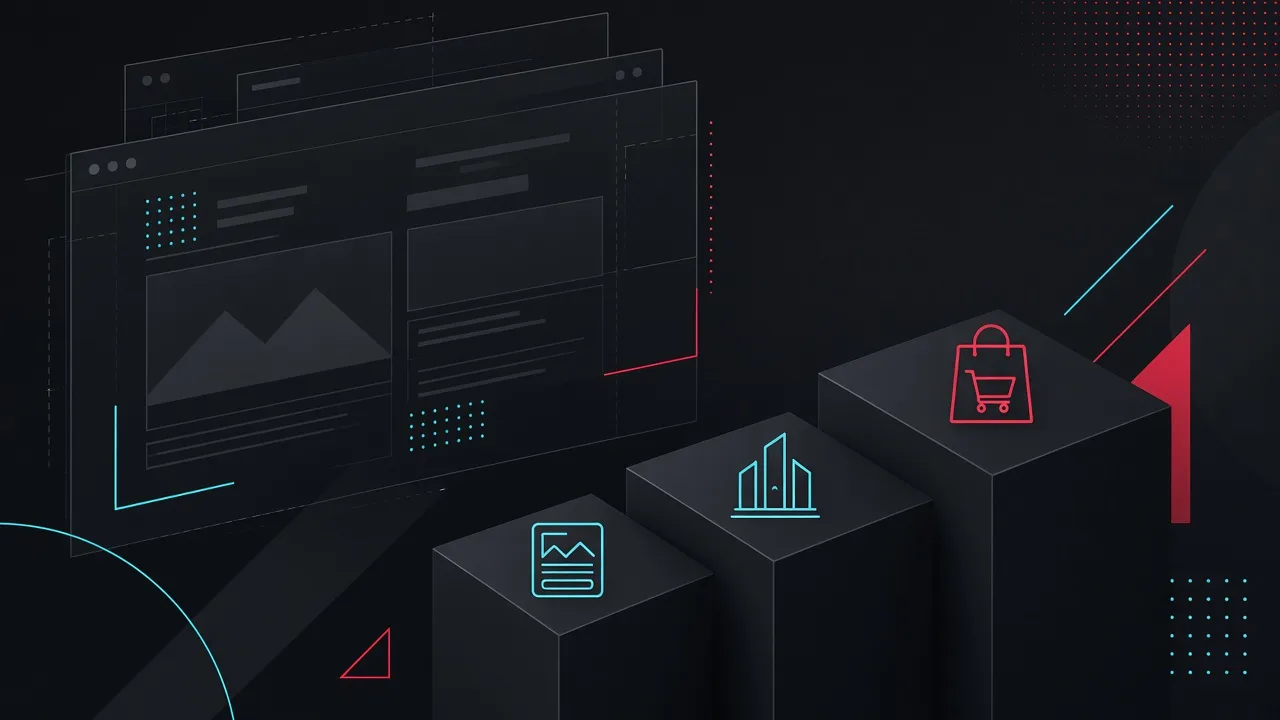
If you are planning a new website in 2026, the first useful question is not “What is the average price?” — it is “What outcome should this site produce?” Lead generation, product sales, hiring, or product demo all imply different information architecture, design depth, and engineering effort.
What drives website cost
Budget is shaped by a small set of levers:
- Scope — number of templates, user flows, and content types.
- Design — template-based UI vs a custom design system.
- Engineering — forms only vs CRM, payments, accounts, or external APIs.
- Content — whether copy, photos, and product data already exist.
- Launch quality — performance, accessibility, analytics, and technical SEO basics.
Common website formats
Landing page — one focused offer, fast to ship when the message is clear.
Corporate multi-page site — services, about, cases, contacts; needs consistent templates and navigation.
E-commerce — catalog, cart, checkout, and operational integrations; usually the largest leap in complexity.
Custom web application — product logic beyond marketing pages; estimate from user stories, not from “number of screens” alone.
Costs teams often underestimate
- Content production and migration
- Integrations and edge-case QA
- Post-launch support and iteration
- Rework caused by unclear requirements
SEO and GEO foundations
Search and AI-answer surfaces reward clear structure: meaningful headings, crawlable HTML, accurate business facts, and pages that answer real questions. Foundations belong in the build; ongoing promotion is a separate engagement.
How to brief an agency
- Business goal and primary conversion action
- Audience and geography
- Must-have integrations
- Content readiness
- Timeline constraints
- Examples you like — and why